These days it's hard to convey the excitement of waiting for the train to pull into a small prairie town a hundred years ago. That's what people did, because the train was the lifeline to everything not grown or made in the town. An elderly woman still tells about meeting a December train with her grocer father--one of the boxcars contained the barrel of Eastern oysters and the crate of the only oranges folks saw all year. Christmas dinner came on the train!
HO scale boxcars let you feel some of that anticipation. From slotted cars for livestock to weatherproof ones for all the essentials and entertainments of life, HO scale boxcars provide space for exciting to-scale contents, from cattle to pianos! Whether you build your own or buy, boxcars bring both history and creativity to your layout - load 'em up and move 'em out! Somebody's waiting for what they bring.
Welcome to the summit of railroad history! Invention of the locomotive changed the world as few other inventions did. Until the steam engine rolled down its metal rails at the astounding speed of over 10 miles an hour, people had conquered the land by foot and animal power. With the exception of occasional ocean or river voyages, most people lived and died within five miles of where they had been born.
HO scale locomotives make this extraordinary history come alive. From "The General" to Accela engines, HOs provide the fittings and details that reflect the ambition, ingenuity, and creativity that went into conquering the vast expanses of India, Asia and the American West. Model locomotives reflect all the innovations that made engineers captains of the land. (Some add real train sounds and smoke to further enhance the voyage into railroading history.)
Like all famous leaders, locomotives come with distinctive and exciting stories. Get acquainted with these handsome technological wonders that changed the world.
Like tank cars, hopper cars are the workhorse cars for bulk commodities. For coal, cement, sand, fertilizer, wheat and even sugar, hopper cars are essential to moving products from field to factory. Covered hoppers protect agricultural and other bulk loads from weather. Open ones handle coal - trains of up to hundreds of cars still bring this essential fuel-source out of Pennsylvania mines. (Watching a coal train can challenge the most meticulous of car-counters!)
HO scale hopper cars reflect both the need for stable loading and the mechanics of moving loads to other means of transport. You may even wish to add an HO scale model truck bay to your layout to complete the experience of working with hopper cars. For young railroaders, hopper cars provide great geography lessons as well as a fine rail experience.
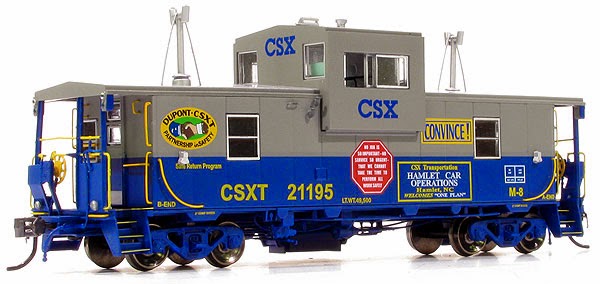
Next to the engine, the caboose is probably the most exciting car for young railroaders. Learning about this work-room on wheels is fascinating - so that's how they fixed things! Further, the notion that railroad workers needed a place to eat and sleep while rolling along provides a window into just how far trains could go. (It's no coincidence that railroad museums nearly always feature a variety of these special cars.)
The special province of railroad workers, caboose designs are as varied as the roads that provided them. Unlike freight or passenger cars, cabooses had to fit a wide variety of human needs. HO scale cabooses focus on interior details and can be found with working toolboxes -to scale! Building a model caboose puts you in touch with railroad workers in a unique way. And a train without a caboose is like dinner without dessert!
Wood trains come in two types - for very small engineers and for big ones. Wooden die-cut kits enable model-builders to craft their own cars and haul them with historic or modern powered engines. Modern kits use new technology to bring back the old days.
Wood trains for young children are a wonderful way to start a train hobby. They offer real hands-on experience, letting the young engineer provide the push-power to make the train go. Most feature magnetic couplings to provide easy car-coupling (and an interesting lesson on the power of magnets' capacity to both pull and push as an added bonus. Available from Maxim, Maxim/Lionel, Brio and the Thomas the Train folks, trains can be as long or short as you want. Some come with cargoes or human and animal passengers. Call them push-trains if you want - or call them imagination-trains, because that's what they bring to children.
These exquisitely-crafted models are the prize of serious collectors. These days, most are imports but pay homage to famous and workaday American trains in great variety. Brass trains come in 0, HO, N, S, and Large Scale. Polished brass trains produce a gleaming flash on the track, although purists may point out that real trains were never all-brass. Brass trains can also be found with enameled, accurate detail in correct road and model colors. The only visible brass is that correct to the original train.
Caution to brass train owners - just like old-time rail-workers, you now have polishing duty. No engineer would drive a brass-trimmed engine that didn't shine like the sun! Model brass tarnishes just like big-engine brass.
And a sad note: aside from the work of a few small independent builders and repair-craftsmen, American brass engine builders are gone. Pecos River Brass just posted a goodbye online. Imports from Japan, Korea, and Europe abound.
The great question about tank cars is "What's in there?" Subtle details give you clues about whether there could be milk, vinegar, chemical solutions, compressed gasses, petroleum products, vegetable oil or even pickles inside, and HO models reflect those details. Building your own tank cars lets you explore the details, because the challenge isn't just what's in there--it's how do you get what's in there in and out! Manways, ladders and hatches are all reproduced from big cars dedicated to specific products.
Building your own HO scale tank cars is probably the not first task for beginning modelers--getting it right in 1:87 scale is fairly exacting--but you'll learn a lot about railroad safety in the process. Even today, a railroad accident involving the contents of a tank car can clear an entire community because of a chemical spill. These hardworking, safety-minded cars are an important addition to any working freight setup.